Total Pageviews

Blog Archive

Search This Blog

Featured

Featured (7)

Branches

Victor Roosensplein 7
2170 Merksem
Gsm: +32 488 10 59 38
Fax: +32 2 212 19 03
antwerpen@fedactio.be
Martelarenlaan 46
3500 Hasselt
+32 11 43 64 05
Fax: +32 11 43 65 40
limburg@fedactio.be
Kartuizerlaan 107
9000 Gent
+32 483 65 18 59
gent@fedactio.be
Rue jumet 175,
6030 Marchienne au Pont
Tel: +32 71 13 80 30
GSM : +32 472 854368
hainaut@fedactio.be
Rue de Fexhe 26,
4000 Liège
Tel: +32 4 233 54 52
liege@fedactio.be

Banner

Banner
Showing posts with label Fedactio Activities. Show all posts

CIVITAS 2023 and the Transformation of European Youth through Active Citizenship

CIVITAS 2023 and the Transformation of European Youth through Active Citizenship


The EU's fundamental principles and ideals serve as a compass for a more inclusive and progressive society. Youth, as the future European citizens, must have their voices amplified, participating actively in decisions that shape their destinies. They are often at the forefront of change, with fresh perspectives and innovative ideas for a better world. However, many young individuals miss opportunities to engage with the EU due to barriers like limited knowledge of the Union's workings, media literacy gaps, and a shortage of critical thinking skills.

The CIVITAS, an Erasmus+ funded project aimed at promoting active citizenship through youth work. From September 29 to October 7, 2023, representatives of Fedactio embarked on a week-long training journey in Veli Iž, Croatia. Hosted by Udruga Prizma, an association dedicated to empowering young people and youth workers across Croatia and Europe. This training provided a nurturing environment for various participants from different cultures and countries to connect, share experiences, knowledge, and viewpoints.

The overarching goal of the CIVITAS project is to elevate the quality of youth work within partner organizations by primarily focusing on non-formal education methods. This comprehensive effort involves enhancing the knowledge of youth workers concerning the functioning of the EU, its common values, and fundamental rights. Simultaneously, it equips these youth workers with the essential tools to promote media literacy and nurture critical thinking among young people. And it also try to teach young people, how can they contribute to their communities through active citizenship. Additionally, the project fosters a collaborative environment that facilitates the exchange of experiences among participating organizations. This exchange of insights and best practices serves to leverage non-formal education as a potent vehicle for promoting active citizenship among the youth.

Nine countries, including Udruga Prizma from Croatia and Fedactio from Belgium, took part in this transformative training initiative. The partners included Ottovolante Sulcis from Italy, VitaTiim from Estonia, Splora from Spain, Young Folks from Latvia, Tavo Europa Lithuania, Sdrujenie “Nadejda CRD” from Bulgaria, IGOR from Croatia. This diverse consortium converged with a shared purpose - to empower young Europeans with knowledge, skills, and a sense of unity.

During the training sessions, participants engaged in active discussions centered on critical topics such as the European Union (EU) and its fundamental values, including an exploration of fundamental rights. Delving further into the realm of media literacy and logical fallacies, participants dissected the intricacies of discerning credible information in today's digital landscape. These discussions provided valuable insights into identifying logical errors and biases in media and political discourse. Additionally, participants explored ways to foster media literacy among young people, equipping them with the tools to navigate the information age with clarity and discernment. The training also touched on the importance of voting, pondering the universal applicability of EU values, and contemplating concepts like equality, equity, and the role of non-discrimination policies in nurturing active citizenship. Participants also delved into strategies for electoral system reform and methods to invigorate political participation, all within the context of their training on EU-related topics.

A diverse range of engaging non-formal education activities enriched the training experience. Participants had the opportunity to partake in a "World Cafe" session, where they explored the concept of active citizenship in an interactive and dynamic setting. The "Percipio Game" added an element of gamification to the learning process, making it both enjoyable and informative. Meanwhile, the "Four Corners" activity delved into EU values and their relation to active citizenship, prompting thought-provoking discussions. Workshops were also an integral part of the training, with one focusing on logical fallacies and mental biases, equipping participants with critical thinking skills. Another workshop tackled the critical issue of fake news, arming attendees with tools to navigate the information landscape discerningly. Lastly, "Fishbowl Conversations" provided a forum for in-depth discussions on the intersection of youth and active citizenship, fostering meaningful dialogue and exchange of ideas among participants. These innovative educational activities not only enhanced understanding but also encouraged active participation and engagement among trainees.

In summary, CIVITAS 2023 has been a vital stepping stone towards nurturing active citizenship among European youth. Through interactive training sessions and engaging activities, participants from nine countries gained valuable insights into EU values, media literacy, and critical thinking. This initiative, funded by Erasmus+, has equipped these young individuals with the knowledge and skills to empower the next generation of active citizens. As they return to their respective communities, they carry with them the tools to promote meaningful change, fostering a brighter and more inclusive future for Europe.

This article reflects the views only of the authors (Suleiman, Ayperi, Ihsan and Burak), and the Commission cannot be held responsible for any use which may be made of the information contained therein.

Open Call for Youth Advocacy Team Members


Project: Citizen Z - Enhancing Civic Engagement and Democratic Participation

Click here to open the PDF version

Application Deadline: 4 September 2023


Are you a young person aged 18-25 who wants to make a difference in society? Do you want to be part of shaping the future of democracy, education, climate action, employment, and other important issues in Europe? If so, we invite you to join the Youth Advocacy Team of the Citizen Z project.

Contemporary political attitudes often show disengagement and indifference, particularly among young people. The Citizen Z project aims to address this issue by empowering EU citizens, especially the youth, to actively participate in democratic processes and fostering inclusion within the European Union. By joining the Youth Advocacy Team, you will have the opportunity to contribute to strengthening democratic participation, creating informed choices among citizens and address recommendations to the European Parliament.


Objectives of the Citizen Z Project:


  • Strengthen democratic participation among youth

  • Give young citizens the means to take initiatives and play an active part in civic and democratic life (e.g. Citizens’ Assemblies)

  • Bring young citizens closer to the EU

  • Counter misinformation and contribute to informed choices and decisions among citizens


Opportunities:


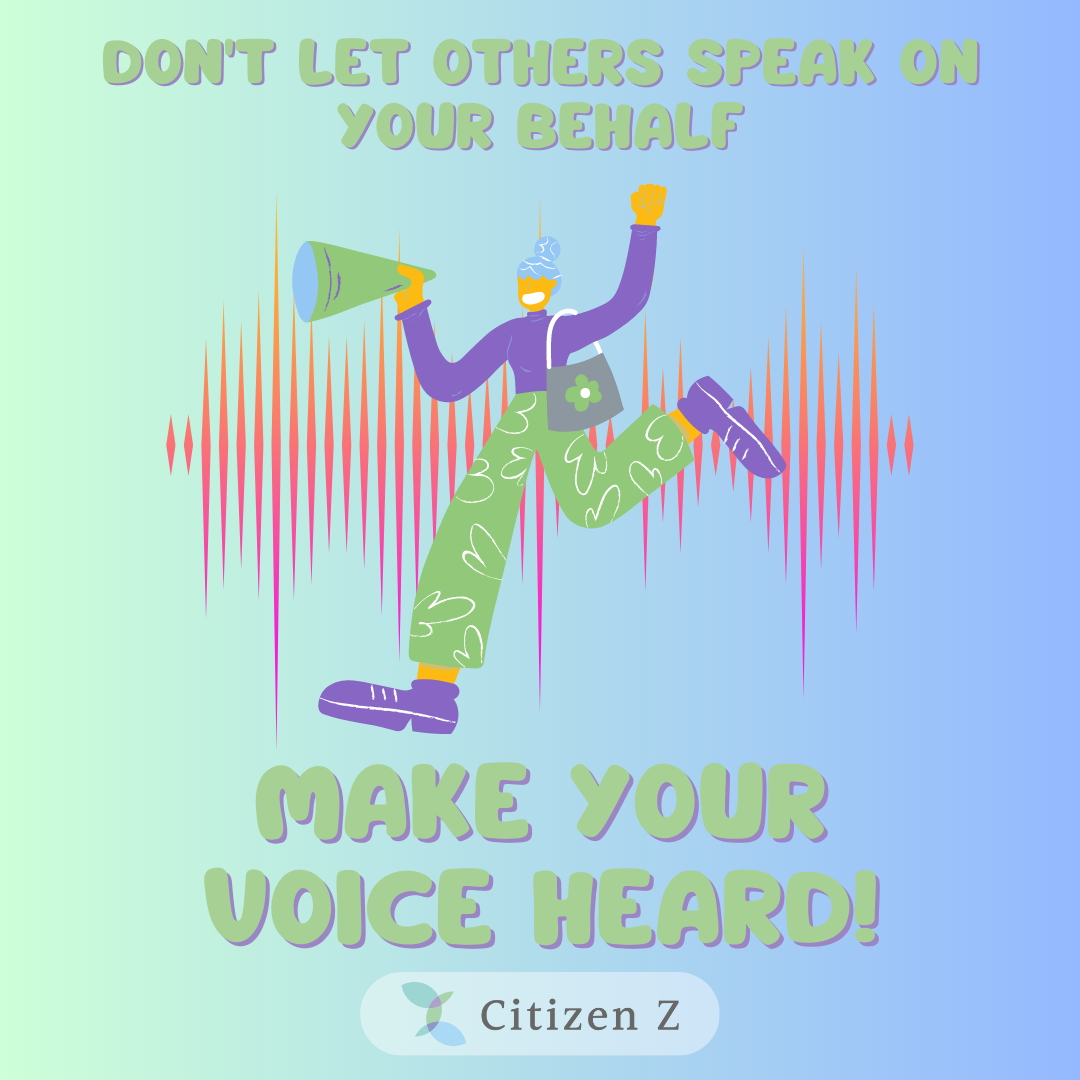
As a Youth Advocacy Team member, your role will be to consult, advocate, and promote the youth vision within the Citizen Z project and beyond. We want to know your point of view and we believe that young people should be empowered to take ownership of the initiative and be their own spokespeople. By joining the Youth Advocacy Team you will be offered the opportunity to participate in youth exchanges (local or/and abroad), summer school programs and certified training. You will have the opportunity to attend external events at the EU institutions using our network, to participate in panels with policy-makers and other stakeholders and to meet the experts of your priority topics. You will also have the chance to participate in cultural and team building activities, to publish on the subject of your interest and to shape and organize events on the topics of your interest. Don't let others speak on your behalf—take action and advocate for young people. Make your voice heard!


Responsibilities:


  • Participate in bi-monthly meetings

  • Contribute to the activities of the Citizen Z project

  • Engage in deliberations on various topics of public interest

  • Promote the interests, vision, and priorities of young people 

  • Advocate for specific issues and raise awareness

  • Collaborate with a diverse team of engaged young individuals

  • Collaborate with external organizations and attend events at places such as the European Parliament, European Committee of the Regions, Emergency Response Coordination Centre, etc.

  • Network with other young advocates and decision-makers


Requirements:


  • Aged between 18-25 years

  • Fluent in English (French or Dutch is a plus)

  • Strong interest in democratic participation, political processes, and societal issues

  • Ability to work effectively in a team and contribute to constructive discussions

  • Willingness to engage in regular meetings and project-related activities


How to apply?


To apply for the Youth Advocacy Team, we invite you to send us:

  • Your Curriculum Vitae (CV): Provide a detailed summary of your background, education, work experience, and any relevant achievements.

  • Motivation: Share your motivation for joining the Youth Advocacy Team. You can choose to express it in the form of a letter or a video, showcasing your enthusiasm and explaining how you would like to contribute to the Citizen Z project. 

or 

Tell us what are your areas of Interest.

or

Answer this question: What are the most important issues to be addressed in nowadays society? How does it relate to you? (max ½ page).


Please send the following to info@fedactio.be and info@dialogueplatform.eu by 4 September 2023 at the latest. If you have any further questions, feel free to reach out to us at the provided email addresses. Good luck with your application!

Text

Description automatically generated

Interview with Henri Goldman about the importance of living together in peace

In commemoration of the 75th anniversary of the liberation of the Auschwitz-Birkenau concentration camp, Fedactio and IDP interviewed "Politique" Editor-in-chief Henri Goldman, who talks about his family's experiences in Auschwitz during World War II.

Click here for the full video


Hello, Mr. Goldman! Could you introduce yourself in a few words and tell us a little bit about the tragedy that has affected your family? 

I was born here (Brussels) in 1947. So, I was born after all this. I don't know of the whole story we are going to talk about except what I have been told. But I lived it quite intensely through complicated family situations. I have to go back a generation. My parents are Polish Jews, born to families that have been there forever. They come from two cities, both about 50-80 km from Warsaw. At that time, there were about 3 million Jews in Poland. Between the two wars the Jews faced two types of difficulties. Firstly, socio-economic misery because the country was going through a crisis. We are after the crisis of '29, in a country that is not very prosperous. And then there's a tradition of anti-Semitism that becomes really unbearable with the rise of Polish nationalism which organizes boycotts: "Don't buy from the Jews." As the situation is difficult, they send children abroad. My parents, who don't know each other yet, come to Belgium as economic migrants, but also to flee anti-Semitism. Then comes the war. You know about Nazism and its racial laws, that Jews are persecuted in Germany. In the spring of 1942, the so-called Final Solution came into effect. There is one too many people on earth; we must not only discriminate against them, beat them, imprison them, but we must exterminate them. A decree of the occupier orders all Jews to show up and introduce themselves to the Dossins barracks in Mechelen to... go to Germany in a labour camp, although they are not really told why. What is important is that it only concerns foreign Jews at the time, so the occupier is going to get some kind of ambiguous collaboration with the Belgian Jews by telling them "you risk nothing at all, but you must help us". As in the Netherlands and France, national Jewish associations were set up. The arrest of my father arrived rather late, I do not know the details, he will be deported in February '44. As for my mother, she was deported in January '44, almost at the end of the war. When in 1942 the decision to deport foreign Jews was taken, she immediately contracted a white marriage to become Belgian. This is a procedure that many migrants used to have security of residence. Once she became Belgian, she joined the Resistance, and it was not until October 1943 that the deportation was to include Belgian Jews as well. She then went underground and was arrested by denunciation four months later. They both ended up in the Auschwitz camp where the train from Mechelen arrived. My father will be deported with his wife and the youngest of his three children and they arrive at the so-called ramp in Birkenau, the terminus station. There, people are sorted as they arrive; those who can still work as slaves enter the camp, and those who are considered useless immediately go to the gas chamber. That's what happened with my father's wife and their youngest child. The other two children were in hiding with Belgian families during this time. When my mother returned to the camp, she was a little woman, she was not even 1.5m tall, but she was vigorous. I learned a few years before her death that she had arrived pregnant at the Auschwitz camp, that she had given birth there, and with friends who worked in the infirmary they euthanized this little girl who was in full health to prevent her from being subjected to the medical experiments of Dr. Mengele, a war criminal. My father was later transferred to the Dachau camp. In a way it was fortunate because it was a pure labour camp, without gas chambers. He was liberated by the Americans, while my mother stayed all the way to the Auschwitz camp and a few days before the Soviet troops arrived began what was called the death marches. At that time there were about 100,000 people left in the Auschwitz camp and the Nazis took them with them in their retreat. It was in January in the middle of winter, it was freezing and this caravan of poor people came up to Germany. It took several months for them to run into French or American people who repatriated them. My parents met after the war. I was fortunate to have an extraordinarily alive mother, for whom life went on as did the fight against fascism. She pushed me to get involved in life and made me, I hope, a balanced and rather optimistic man.


Perhaps a brief word about who Henri Goldman is today, about your work and your commitments? 

This context has always made me a politically and socially committed person. Because of this family history, the hard core of my commitment revolves around the rejection of racism. More than that, there is also the recognition of cultural diversity. I am very happy to live in Brussels, which is a city where even today the majority of people are either foreigners or of foreign origin. It is an extraordinary richness not to have a culture of reference. And it is no coincidence that out of the 695 local councils that we have elected, there is not a single one from the far right. This is unique in the European landscape. When you look at what is happening in Flanders, France, the Netherlands, Germany, England, Italy and Spain, you see the emergence of mass parties everywhere. I think it's thanks to the "cosmopolitan" identity of Brussels that we don't have that. It shows that more cultural diversity leads to more democracy and openness. Besides that, I have a degree in architecture, but I've done six jobs in my life, around music, journalism, writing, page layout... (Mr. Goldman is currently editor-in-chief of the magazine "Politique".)


This Monday, 27 January, we commemorated the victims of the Holocaust with this year's focus on the 75th anniversary of the liberation of the Auschwitz camp. Who do you think is responsible for what happened to the Jewish people? Is it solely the fault of the Nazi regime or is there a more collective responsibility?

There is a collective responsibility that is historical, and then there are much more specific political responsibilities. Jews are the only non-Christian minority that has existed for a long-time all-over Europe, from Portugal to Russia, from England to Bulgaria. And it is on the Jews that the need to express a difference has focused. For a long time Jews were locked into a very specific economic function. If Jews became usurers, it was because they were not allowed to own land at a time when society was living off the land. By forbidding them to own land, they were forced to have small commercial functions. And then when a bourgeoisie developed in Western Europe, they were pushed eastward. They lived through pogroms, professional prohibitions, numerus clausus at the university when they have started to be able to study, etc. Structurally in European society there is a need for a permanent scapegoat, and at a time when we have no Arabs, no blacks yet, it falls on the Jews. Now there are much more conjunctural events that have plunged Europe into war. The advent of Nazism is not unique, we see the arrival of autocratic nationalist regimes in many places. The question of why genocide took such a prominent place in this war is something very difficult to explain and understand. It doesn't make sense. It makes sense for a criminal authoritarian regime to turn an entire population into slaves, but it does not make sense to decide to liquidate them industrially. Other countries have experienced genocides, such as the Armenian genocide or the Tutsi genocide, which are the two other major genocides that have been recorded. It was done in a planned manner, but not in an industrial manner, as was the case with the Jews. That's what's quite unique. How can a people that is considered at the time to be one of the most civilized...like the people of Goethe, Schiller, Karl Marx, Freud, Einstein, etc.... How can a people that is one of the most evolved in Europe at a certain point forget its culture to make this? It is not the least civilized people who are capable of the most barbaric crimes.


This year many leaders from the Muslim community participated in the Auschwitz commemorations. Do you think that dialogue between different groups can be a remedy against radical ideologies?

Muslims have been widely accused of being the vectors of a new anti-Semitism. It is important to show that this is not true and that they empathize with the suffering of the Jews. There are also fine initiatives in the other direction, such as the iftars and exhibitions organised by the Jewish Museum in Brussels, which are an extraordinary moment of sharing. There are fruitful elements. It is important to note that Islamophobia and anti-Semitism are developing at the same time, and we must combat them together.


Today we can see that hate speech is on the rise in European societies. Why do you think there is so much hate in today's society? 

We're coming out of a period called the glorious thirty years (1945-1975). An exceptional period for Europe... even if it coincides with the golden age of colonialism. It is a period of growth, there is no unemployment, wages are rising steadily, public services are improving, pensions are also improving, the pie of the economy is growing so much that everyone, both bosses and workers, is earning more. And then all this will stop from the '75's onwards. For ten more years, we will pretend that everything is going well, that the situation will improve, and then we realise that it is no longer the case. Unemployment increases again, the social balance of power deteriorates and little by little people say "I am not sure that my children will live better than me. What can be done? To whom?" And then the old nationalism resurfaces and says it's other people's fault. We have to take care of our poor but we can't do it because all the poor people in the world are coming to invade us. Nationalism rises and revolves around refusing the other, the foreigner. The prosperity of capitalist societies is at a standstill. We realize that it no longer works, that we are no longer able to ensure a regular increase in the middle classes. There are new middle classes emerging in China or India, but the middle classes in Europe have collapsed. And on this basis, a discourse of exclusion has developed. The liberal economy no longer works and the left has not managed to impose another form of solidarity, so the extreme right is taking advantage of it. It is based on this old xenophobic background that exists in all societies where there is a very powerful national history.


Polarisation of society is very common today in our western societies, including in the countries of the European Union, and in the United States, which are said to be great democracies. In your opinion, is this a sign that democracy is in danger?

What we call polarization is an effect of the breakdown of solidarity. In order for it to take hold, you have to designate an otherness, and it always falls on populations of foreign origin, or in the United States on minorities. To say that black Americans or Hispanics are of foreign origin, yes, a very long time ago. But then all Americans are of foreign origin! It's all just a construct. In Europe this discourse has taken on new proportions with the new waves of migration.


Unfortunately we are still witnessing persecutions in 2020. All over the world people are worried about their ethnic, cultural, political, sexual and other backgrounds... Having made this diagnosis, what are the solutions envisaged? What is missing to ensure the respect of fundamental human rights? Are we condemned to see history repeat itself?

I think we are relatively doomed to give up the idea that history is linear and that it will always move towards more progress. This is what we have been discovering for the past few years, and the ecological crisis is not helping. The spiral of consumption and waste will make the Earth unviable. Human societies are going through a difficult time. If populists are getting stronger everywhere, it's because a scapegoat has been appointed. They say "eigen volk eerst", "our people first" and the others they could die. Éric Zemmour, who was asked in a French TV programme "what do you feel when young people die in the Mediterranean", has just said "I don't care at all, they took their risk. I'd rather they die than my own children". We are at that point when we don't really see how we're going to get out of it anymore. On the other hand, there is a lot of hope coming from the youth movements, the whole mobilization for the climate for example. It's a step forward... I think we need a profound cultural change to consider first of all that intangible goods, tenderness, love... are more valuable than material things. That said, we need at least enough food, clothing and shelter. I don't rely so much on the political world to initiate change, but more on the associative world. How do you convince dominant, powerful people to give up their privileges? It's difficult to convince them. In general, people who have privileges don't abandon them of their own free will. It is often necessary for less privileged people to snatch them away. That's how the whole history of human emancipation works. If certain African peoples had not fought for their independence, they would not have had it. If women had not fought for more equality, and it's not over, nothing would have changed, it would still be men who would decide everything. And if the workers hadn't fought for social rights, it wouldn't have been the capitalists who would have given them like that. We have to accept that society is an space of conflicts, that there are social, economic and cultural struggles. The dominated groups must take their destiny into their own hands. They must obviously do so in a way that does not lead to a reversal of domination. The history of human emancipation is not linear. There have been times when we moved forward and times when we moved backward.


What place do you give to intercultural dialogue in the resolution of the problems we discussed?

For me, the very existence of a multicultural city prevents a nationalist conception of things and forces one to be a little less self-centered. I have to be able to understand that this is important for a person who has another origin. That doesn't mean that they should remain locked in what they have received. But that this is their starting point and that if I want to make this person my equal, I must accept that this person's cultural baggage is as valuable as mine. The society I really dream of is a society where no one has to choose between being faithful to one's own baggage and making society all together.


Speaking of dream society. We were commemorating Martin Luther King’s Day on 20 January, what are your wishes, your dreams perhaps more precisely, for future generations? 

We have an incredible wealth that it is up to us to bring to life. It will evolve over time. No one knows for how long we will remain Turkish, Moroccan or Jewish. After how many generations it disappears or not. Then we get married to each other too, things happen. It is by remaining open that we can assume our destiny as the most cosmopolitan city in Europe according to all the statistics, and that we can be a small island of resistance to the rise of identity nationalism. This is what I can perhaps hope for the future.


Speak Right Now: commuters in Antwerp Central stop for a minute to think and act for human rights thanks to Fedactio Antwerp

To celebrate the 70th birthday of the Universal Declaration of Human Rights, Fedactio launched its project Speak Right Now, with events in defense of human rights across the whole of Belgium. Below, you may find a report of one of the events in Antwerp.

On Friday 7 December Fedactio Antwerp put up a stand in Antwerp Central to promote human rights in the context of the project Speak Right Now. Hasty travelers were informed through the numerous flyers at their disposal. Those with more time were invited to participate in the Amnesty International writing session. To reward their efforts, volunteers of Fedactio Antwerp offered them a piece of cake and cup of coffee. Together, almost 150 letters were written.
Behind the writing tables, various testimonials, both of victims and of professionals, were projected on screen. Amongst others, a Syrian refugee was interviewed as well as Kati Verstrepen, president of the Ligue for Human Rights, Ernest Sagaga of the International Federation of Journalists, children’s rights’ commissioner Bruno Vanobbergen and Talha Yildiz of the platform Humanitarian Help and Solidarity. The initiative was lauded by the commuters and received many positive comments.


About potatoes and men: Golden Rose’s kumpir evening


Fedactio Limburg, in cooperation with Golden Rose organised its second kumpir evening on the 18 March 2018. This evening was an ideal opportunity to strengthen the contact with friends, family and acquaintances, to enjoy a delicious meal and to conclude the weekend festively.

Following the success of the first edition, the volunteers of Golden Rose prepared even more delicacies this time. More than 60 people appreciated the effort (and the deliciously baked potatoes). See you at the third edition!


Fedactio’s New Year’s Reception 2018: The art of living together


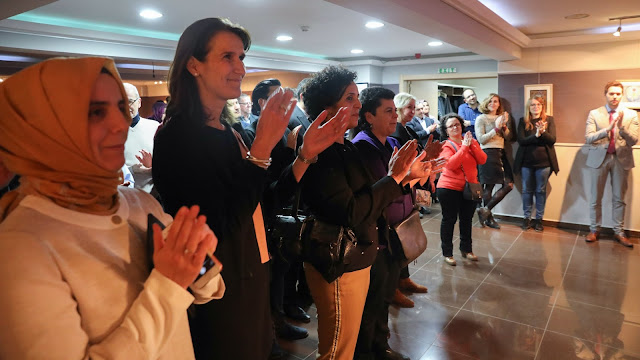
De genodigden klappen voor de inspirerende speech van Musa Soydemir tijdens de nieuwjaarsreceptie van Fedactio voor het jaar 2018.
Happy faces listening to the speech of Musa Soydemir.

Fedactio had a bright outlook on the year 2018 and showed that optimism on its New Year’s Reception, 25 January 2018. From 6 p.m. onwards, guests were welcomed to have a drink and enjoy the homemade delicacies, prepared by our chef for this special event.

Upon arrival, visitors were already tempted with a basket filled with Turkish Fruit and Ferrero Rochers. Many attendees could appreciate this charm offensive, as well as the outstanding speeches of of President Musa Soydemir and General Secretary Ozkan Yilmaz.

Their message was crystal clear: “We stand for the same values on which our organization was built: democracy, freedom of speech, gender equality, social justice, equal opportunities, pacifism and respect towards others, regardless of their beliefs or backgrounds”. After these inspiring words, a short note was dedicated to the events of 2016 before moving on to all of the successful projects in 2017, including the foundation of our new platform “Humanitarian Aid and Solidarity””, and the successful iftarmee/iftarons (iftar with us).


“Nothing will keep us from achieving peaceful coexistence”, stated General Secretary Ozkam Yilmaz enthusiastically. Fedactio continues its activities, thanks to the commitment and support from its employees, volunteers, partners and sympathizers, all of whom will hopefully make 2018 another year to remember. Next New Year’s Reception will undoubtedly be as pleasant and enjoyable as this one.

Education Conference: Diverse Talents for the future of Europe

The Federation of Active Associations of Belgium (Fedactio) organises an international conference on diversity in education and the role of civil society in collaboration with a number of universities and institutions. The conference takes place in Brussels on the 5<sup>th</sup> and 6<sup>th</sup> of March 2012. The opening ceremony and the first session will be held in the European Parliament and the second and the third sessions in the Flemish Ministry of Education and Formation.

The title of the conference is: “Diverse Talents for the future of Europe: strengthening Europe through grassroots civil initiatives in education”. It builds on the goals of the Europe 2020 Strategy for education: to reduce school drop-out rates and increase the level of education for everyone. It is now known that these phenomena often appear to be problematic for youngsters from an immigrant background.
International experts, researchers, policy makers, civil society organisations and practitioners from the education sector will come together to discuss the following three key issues:
  1. Which educational policies are needed to meet the Europe 2020 targets?
  2. How can all young people, including those from an immigrant background, be given opportunities to develop their full potential and contribute to Europe’s future?
  3. How can partnerships between schools and civil society, including the immigrant communities, contribute to achieve the European education ambitions for 2020?
Apart from presentations and numerous discussion moments, you will also have the opportunity to participate to field visits to highlight the practical side apart from the theory. In order to make the conference accessible to all, simultaneous interpretation will be provided into Dutch and French during both days.
You can consult the programme and practical information on www.educationconference.eu. Registration is also possible on the website before Monday February 27th. For any further practical information, please feel free to contact educationconference@fedactio.be.